My report
Cooperation between Morocco and Europe is extremely strong and appears to be deepening further. From an economic perspective, I would even say that Morocco's strategy is to gradually make the country An extension of European supply chains in North Africa, while keeping its doors open to China, the United States, and the Gulf countries.
The EU remains by far Morocco's most important economic partner. In 2025, the value of EU-Morocco trade in goods rose to approximately to 62.2 billion euros. The EU accounted for 33.7 % of Morocco's total trade in goods, and the EU is also Morocco's largest foreign investor. An especially large share of Morocco's exports to the EU already consists of machinery and transport equipment, which indicates that the relationship is no longer based solely on agricultural products or textiles.
Why does Europe want to invest in Morocco?
The first reason is nearshoring, meaning the relocation of production close to Europe. From Tangier to southern Spain is a very short distance. A European company can manufacture a component in Morocco and quickly get it to factories in Spain, France, or the rest of the EU.
For this reason, in particular automotive industry is important. Renault and Stellantis have built a large manufacturing network in Morocco, and an ecosystem of hundreds of component suppliers has formed around them. At the same time, Chinese battery and component companies are locating in the same areas. Thus, Morocco could become a place where European automotive industry and Chinese battery technology meet.
Another major reason is energy. In the future, the EU will need a lot more renewable electricity, green hydrogen, and low-carbon industrial products. Morocco has exceptionally good solar and wind conditions and is geographically close to Europe. Therefore, the development of electricity grids, renewable energy, and potential future energy connections is strategic for the EU.
In 2025, the European Investment Bank granted record-breaking amounts to Morocco 740 million euros in new funding, more than in any year since 2012. Of that, for example, 170 million euros went to the modernization of the electricity grid and the integration of renewable energy. In 2026, the EIB also announced 365 million euros financing for the improvement of Morocco's road and rail networks.
Morocco is actively trying to attract more European investments
I don't think Morocco's goal is just to say anymore:
“Come here because labor is cheaper.”
The strategy is shifting more in this direction:
“Come here, because there is a ready-made automotive industry, ports, renewable energy, infrastructure, connections to Africa, and a very short supply chain to the EU.”
This is a considerably stronger investment story.
approximately of the European Investment Bank's funding to Morocco over the past ten years 40 % has targeted SMEs and industry, 19 % to renewable energy and 17 % to sustainable transport.
Tangier is very important here
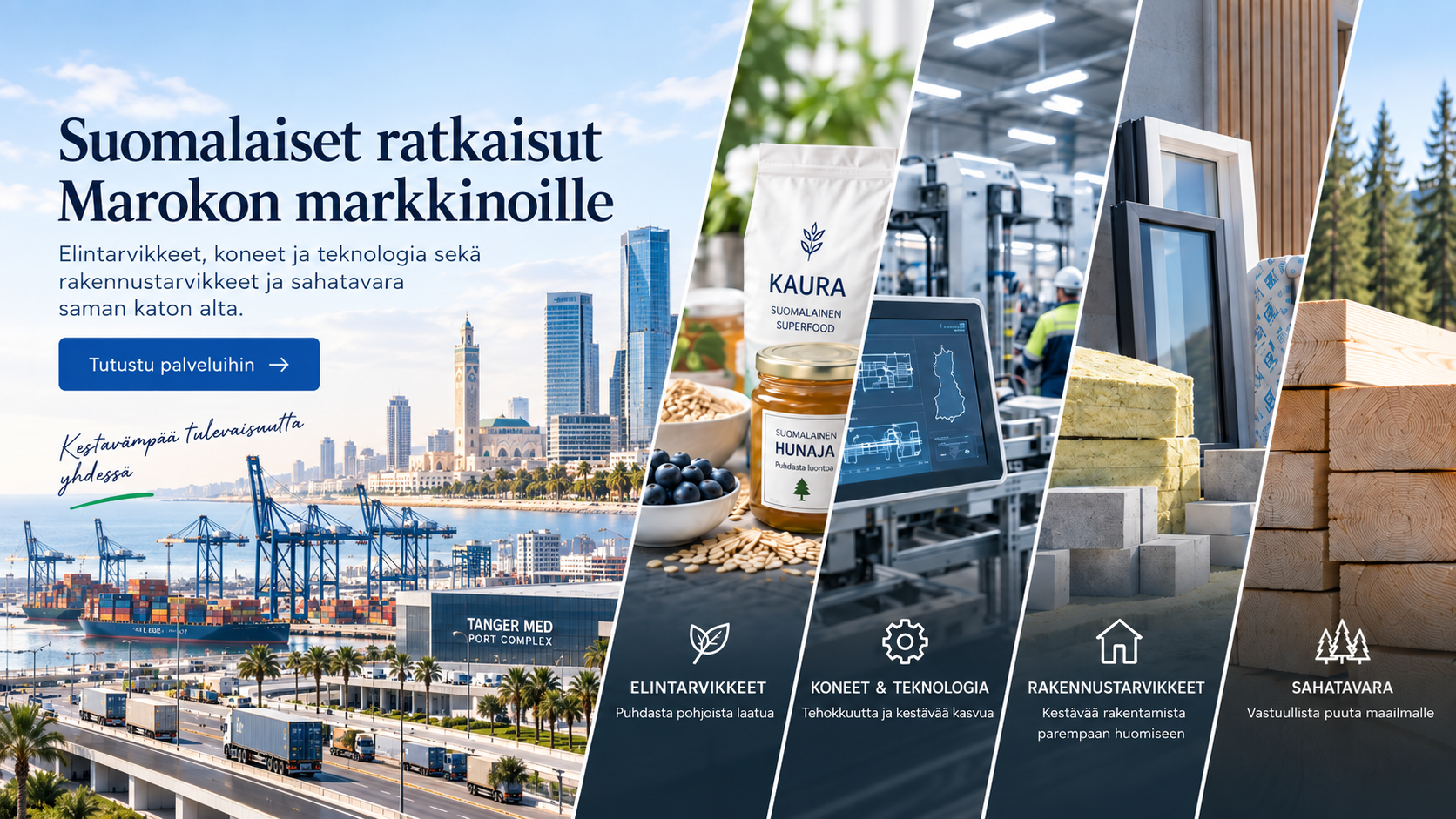
The area that has formed around Tanger Med is practically one of Morocco's greatest competitive advantages.
For example, a European factory can:
import components → manufacture or assemble the product in Tangier → ship it to Spain or France → integrate it into the EU supply chain.
Because of this, the Tangier-Kenitra axis has developed into one of Africa's most important automotive industry hubs.
And when Chinese battery and material manufacturers come to Morocco at the same time, European car plants can theoretically get increasingly more electric car components right next to the EU.
Money is also being pumped into infrastructure
Europe is not only investing in factories.
Money is currently being spent, for example, on:
to electricity grids, renewable energy, railways, roads, water supply, ports, SMEs, and industrial areas.
The EIP's cumulative financing in Morocco has already risen to over to 12 billion euros since 1979.
This is important because good infrastructure makes private investments easier later on.
For example, if the electricity grid is not sufficient for a large battery factory or the railway connection to a port is poor, a company will not invest. EU public funding helps to remove precisely such bottlenecks.
The EU itself now wants to deepen the relationship
In January 2026, the EU-Morocco Association Council met in Brussels. The parties stated their objective to restarting and deepening the partnership for example in trade, investments, the green transition, innovations, and security. The EU explicitly calls Morocco a strategic key partner in its southern neighborhood.
Morocco is also the EU's largest recipient of funding in North Africa. Between 2021 and 2024, funding for EU bilateral programmes and EFSD+ arrangements averaged around 270 million euros per year, in addition to investments by the EIB and the EU countries' own financial institutions.
One thing makes the situation particularly interesting: China
As I see it, Morocco is trying to build a model where it doesn't have to choose:
Europe or China.
Instead, it can try to get:
Chinese battery technology + European automotive industry + Moroccan production + access to the European market.
If this succeeds, Morocco's value to Europe will grow even further.
In the future, a European manufacturer could, for example, source a car battery's cathode material, anode material, copper components, and possibly the cells themselves from Morocco instead of importing everything directly from Asia.
But there are also risks in cooperation
Not everything is unproblematic.
One question is Western Sahara, which has caused legal disputes regarding the EU-Morocco trade agreements.
The other one is growing presence of Chinese companies in Morocco. In the future, the EU may increasingly ask how much of a product manufactured in Morocco is actually Moroccan and how much is practically Chinese production that was merely finished in Morocco.
This does rules of origin a very important question.
Third is the concern of European industry itself. If companies move too much production to Morocco, Europe may start to see Morocco not only as a partner but also as a competitor in, for example, automotive components, textiles, and other manufacturing.
My interpretation
I currently consider Morocco's Europe strategy to be very strong.
Morocco will probably not become an EU member, nor is it actually aiming for that. But economically it is trying to reach a situation where The EU's industrial supply chain does not end at the coast of Spain, but continues across the Strait of Gibraltar to Tangier, Kenitra, Casablanca, and elsewhere in Morocco.
Therefore, I would describe the situation like this:
Morocco is not turning into a European country, but its economy is becoming an increasingly European-integrated production hub.
If Morocco succeeds in uniting European market + Chinese technology + domestic renewable energy + Tanger Med + automotive industry, the next 5 to 10 years could bring a very large new wave of investment into the country.