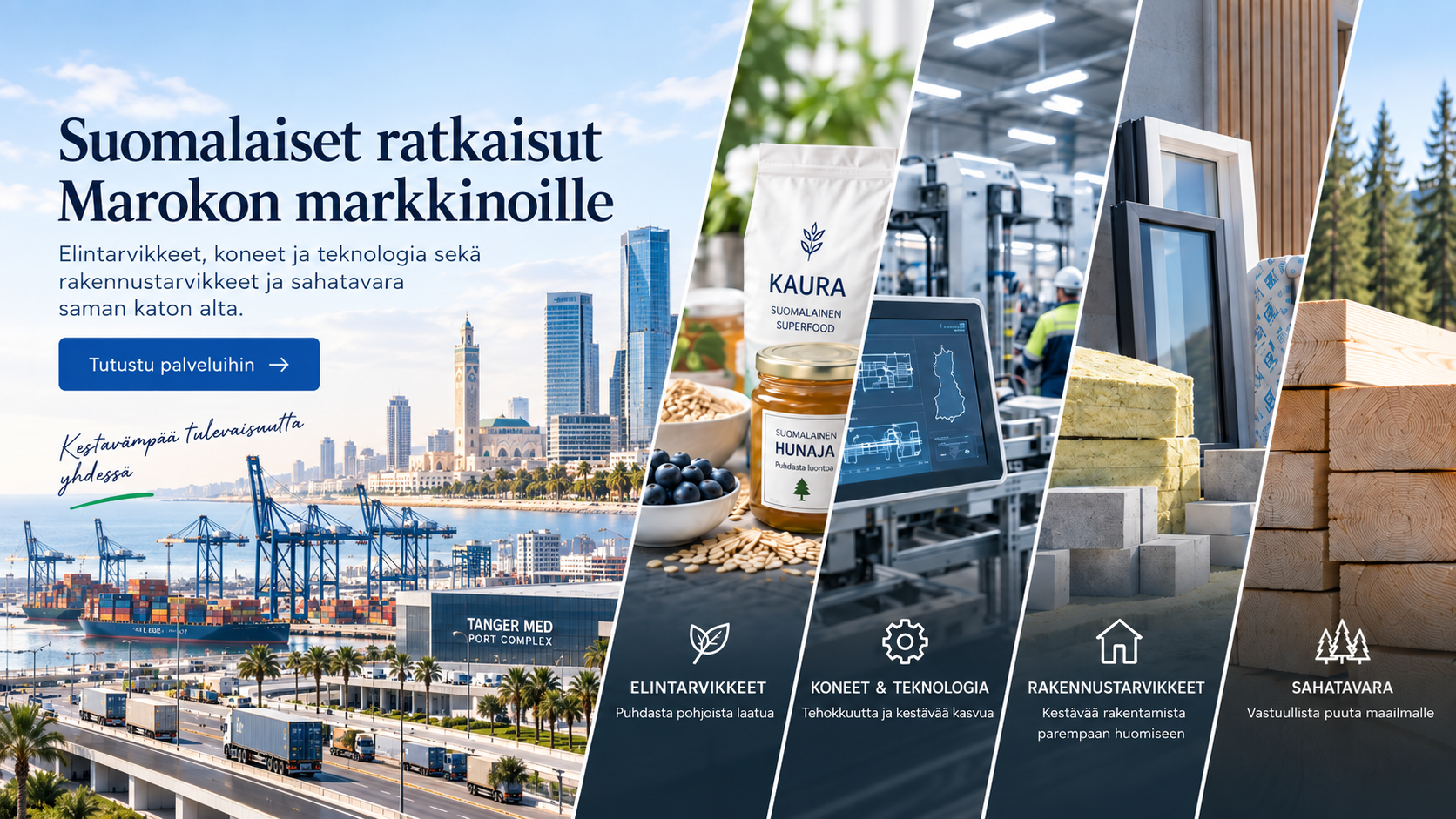
Food products
When it comes to food products, I would approach Morocco differently than with timber: Instead of mass products, you should aim for premium, health, wellness, or specialty products.. Marokon vähittäiskauppa modernisoituu, supermarketit kasvavat ja maahantuojat etsivät uusia tuotteita, mutta vain osa kuluttajista ostaa säännöllisesti kalliimpia tuontielintarvikkeita.
Among Finnish products, I would see the best opportunities, for example, in oat products, functional foods, berry products, baby foods, premium chocolate and confectionery, biscuits, snack products, and some dairy-based products. Instead, in the standard flour, sugar, oil, or bulk grain trade, Finland would easily find itself in pure price competition.
A Finnish one could be of special interest oat. In Morocco, the urban middle class is growing, and healthier packaged foods are attracting increasing interest. Oat drinks, granolas, oat snacks, and high-fiber products could fit this segment. The same applies to Finnish ones blueberry, lingonberry, and other berry products, if they are sold as higher value-added products rather than as mere raw material.
However, importation is strictly controlled
Moroccan Food Safety Authority ONSSA (Office National de Sécurité Sanitaire des Produits Alimentaires) valvoo elintarvikkeiden tuontia. Elintarvikkeen on täytettävä Marokon elintarviketurvallisuuslainsäädäntö, pakkausmerkintöjen vaatimukset ja tuoteryhmästä riippuen terveys- tai kasvinterveysvaatimukset. Eläin- ja kasviperäisiltä tuotteilta voidaan vaatia lähtömaan viranomaisen allekirjoittamia terveystodistuksia tai kasvinterveystodistuksia.
For this reason exporting cookies is much easier than exporting cheese or meat, for example.
If it is an animal-based product, such as milk, cheese, meat, or fish, the requirements are usually clearly stricter. Plant approval, a health certificate, and the cold chain can become decisive.
In practice, I would use a Moroccan importer
For a Finnish SME, the best first model would be:
Finnish manufacturer → Moroccan food importer → supermarkets / hotels / online store / specialty stores.
I wouldn't start by founding my own sales company.
Moroccan importers also often test new products with small initial orders, mikä on itse asiassa suomalaiselle pk-yritykselle hyödyllistä. Maahantuojat etsivät uusia tuotteita, mutta aloittavat usein pienellä määrällä testatakseen kysyntää.
In which products would I see the best opportunities?
I would estimate it like this:
| Finnish product | Potential | Why |
|---|---|---|
| Oat products | ★★★★★ | Health, fiber, premium branding |
| Berry products | ★★★★☆ | Nordic origin, well-being |
| Cookies and snacks | ★★★★☆ | Easy logistics and long shelf life |
| Chocolate/sweets | ★★★★☆ | Market for premium imported products |
| Baby food | ★★★★☆ | Quality and safety can separate |
| Dairy products | ★★★☆☆ | An opportunity, but more regulation |
| Frozen fish | ★★★☆☆ | The market is big, but competition is fierce |
| Fresh meat | ★★☆☆☆ | Strict regulation and halal requirements |
| Bulk grains | ★★☆☆☆ | Price decides |
Halal is important
If the product contains meat, animal-derived ingredients, gelatin or anything similar, The halal issue must be investigated very thoroughly.. In the Moroccan market, this can make or break the product's sales potential.
This problem is much smaller in plant-based products. For this reason, for example, a Finnish oat drink or berry snack is easier to get onto the market than a Finnish meat product.
The packaging must also be localized
It is usually not a good idea to send a Finnish product packaging as is.
In the Moroccan markets, you should be prepared for at least to French and often Arabic product information. Pakkausmerkintöjen pitää vastata paikallisia sääntöjä, ja ONSSA (Office National de Sécurité Sanitaire des Produits Alimentaires) valvoo myös merkintöjen asianmukaisuutta.
Commercially, the packaging could highlight, for example:
Made in Finland
Nordic quality
High fiber
No added sugar
Natural berries
but only if the claims truly meet the regulatory requirements.
Where should I sell first?
The initial target markets would likely be Casablanca, Rabat, Marrakech, and Tangier, because there are more consumers with purchasing power, international hotels, and modern retail trade.
The product could enter a premium supermarket, for example, at a price significantly higher than the local product. In this case, the goal is not to sell to the entire market of 37 million people, but first to that for 10–15 percent of consumers, who can afford to buy imported products regularly.
If I were to choose one Finnish product for testing myself, I would take oat-based snack product or long-shelf-life berry product. They combine Finland's strong image, relatively easy maritime transport, long shelf life, and the potential for a higher margin.