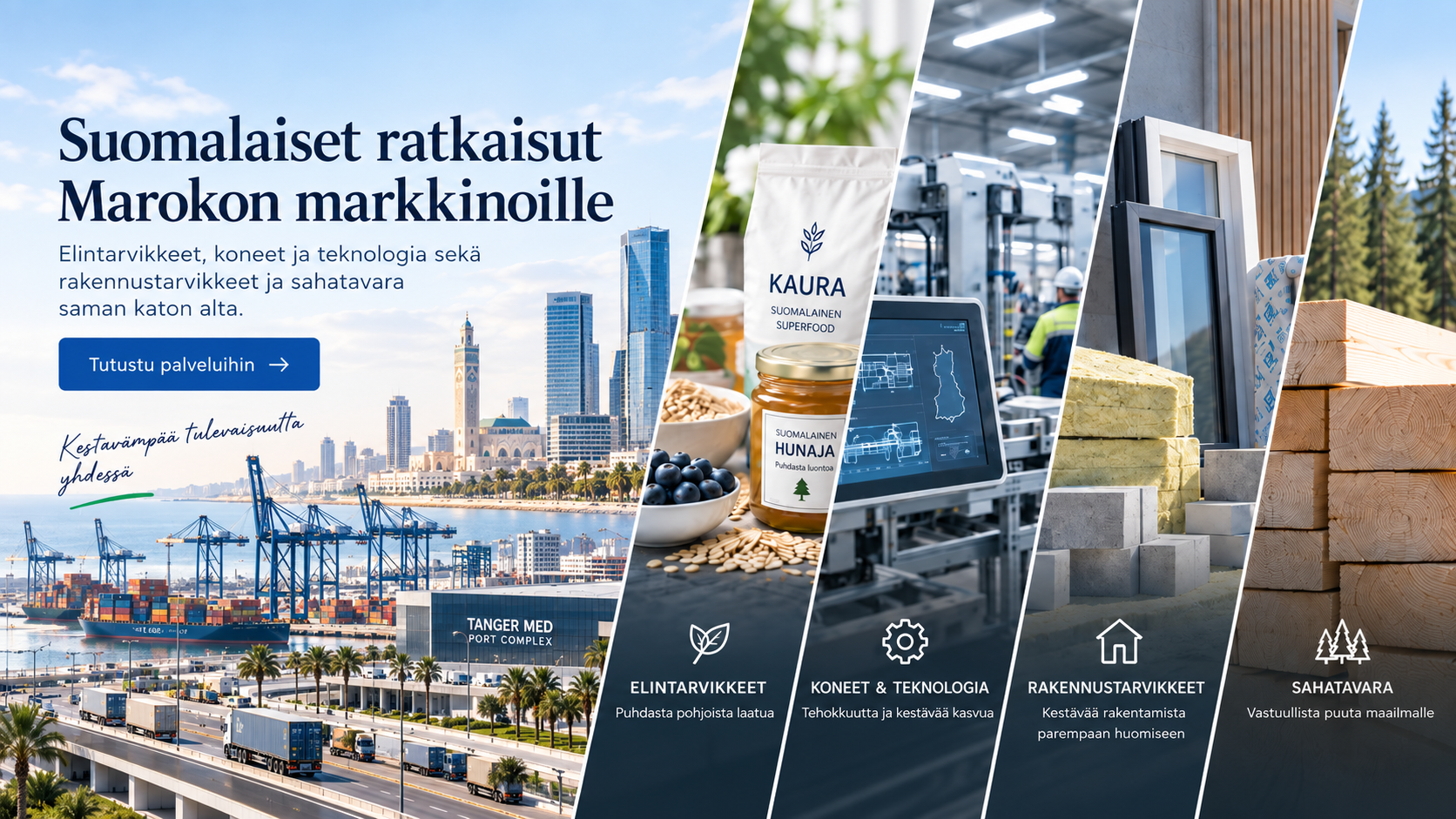
Lumber
timber products, insulation, windows and doors — in Morocco, I would see the best opportunities in a slightly different way.
1. Timber: Finland has a clear strength in high-quality coniferous wood, sawn timber and possibly glue wood/CLT-type solutions. Morocco still imports a lot of construction materials, but at the same time the country aims to reduce its import dependence and replace imports with local production. In August 2026, Morocco’s foreign exchange office estimated that approximately Valued at 21 billion dirhams, And a large part of this is intended to be produced locally in the future.
For Finnish timber, this means that competition based solely on price would be difficult. A better position would, for example, be Strength-graded construction wood, glue wood, interior wood, thermally treated wood, and wood intended for hotel and premium construction.
Sawwood belongs to the scope of phytosanitary inspection in Morocco. According to the regulations of the ONSSA, among other things, supports, sawwood and wooden packaging are included in the scope of phytosanitary inspection during imports. This means that the Finnish exporter must already agree with the Moroccan importer before the first shipment on the necessary phytosanitary documents and requirements regarding the handling of the wood.
2. Insulators: This is, in my opinion, perhaps one of the most interesting categories of Finnish products. Massive construction is currently underway in Morocco, and at the same time, the energy efficiency of buildings, hotels, offices, and high-quality housing are creating demand for better materials. The IMF estimates that Morocco’s investment program for transport, tourism, and other infrastructure for the years 2024–2030 amounts to approximately 190 billion dirhams. The investment rate is estimated to be particularly high in the years 2026–2029.
Things that might be of interest to a Finnish company could include:
- mineral and rock wool
- Wood fiber insulation
- High fire safety insulation
- acoustic insulation
- technical insulation for hotels and industrial buildings
- moisture-resistant insulation systems.
However, in this case the selling argument should be changed from a Finnish perspective. In Morocco, the customer is not primarily being sold the idea. “keeps the house warm in winter”, But more:
“keeps the building cooler in summer and reduces the electricity consumption of air conditioning.”
It is a significantly stronger commercial argument in the climate of Morocco.
3. Windows: In this case, I would see a good opportunity especially in high-quality systems. A Finnish company should not try to compete with the cheapest local aluminum or PVC windows. A better market would be:
energy-efficient windows + good sound insulation + sun protection + premium apartments + hotels + hospitals + office buildings.
For example, in Casablanca, Rabat, Tangier and Marrakech, the markets for hotels, offices and high-quality housing could be more interesting than the usual low-cost housing construction.
However, the Finnish triple glazing is not automatically optimal in Morocco as it is. The product should possibly be localize to the climateManaging solar radiation, UV protection, selective glasses, and reducing the load on the air conditioning can be more important features than an extremely low U value.
4. Doors: It is also worth aiming for a higher standard of product in the doors. Possible markets include:
fire doors, soundproofed doors, security doors, hotel doors, hospital doors, technical industrial doors and high-quality wooden doors.
The investments related to the 2030 World Cup do not only concern stadiums. Morocco’s official preparations also include hotels, commercial infrastructure, airports, roads, urban infrastructure, healthcare services, and telecommunications networks. This increases the demand for building materials such as doors, windows, insulation, and interior spaces.
In what order would I go to the market myself?
Of these four, I would currently assess the potential for a Finnish company as follows:
| Product | Opportunity | Price competition | Finland's competitive advantage |
|---|---|---|---|
| Insulators | ★★★★★ | Middle class | Energy, fire and acoustics expertise |
| Windows | ★★★★☆ | Hard | Energy efficiency, quality, sound insulation |
| Special valves | ★★★★☆ | Middle class | Fire, safety and technical doors |
| Wood products | ★★★☆☆ | Very hard | Nordic pine and special products |
This does not mean that wood would not work. In wood volumes can be the largest, But the competition from Scandinavia, the Baltics, Turkey and elsewhere can be fierce.
Important change: don't just think about exports from Finland
Morocco's current industrial policy also makes another model interesting:
From Finland, material/technology → Processing or assembly in Morocco → Sales in Morocco and Africa.
For example, a Finnish window or door manufacturer could in the future manufacture part of its product locally in Morocco. The same could apply to wooden products: Finnish pine wood is transported to Morocco, but doors, windows or building elements are manufactured locally.
This would be well suited to Morocco's goal of replacing imports with local production.
One regulatory issue deserves to be corrected from my previous answer
The Cm marking does not generally apply to all construction materials. According to the current guidelines of the Moroccan Ministry of Industry, the specific Cm marking currently applies to three product groups: certain low-voltage electrical equipment, products subject to EMC regulations, and toys. However, other regulations apply to construction products. mandatory Moroccan standards and conformity inspections for imports according to the product.
For example wood panels They are explicitly among the products inspected at the Moroccan border. The inspection of other regulated industrial products can take place already at the point of origin before exports to Morocco.
If I founded a Finnish construction supplies company with exports to Morocco
My first product range would be, for example:
1. Premium hardwood / heat-treated wood
to hotels, terraces, interior design and architectural projects.
2. Fireproof and acoustic insulation
to hotels, offices, hospitals and industry.
3. Sun protection window with energy-efficient technology
designed specifically for the hot climate of Morocco.
4. Fire- and soundproofed door
for hotel, hospital and public buildings.
In this package, a Finnish company would not compete with the cheapest Chinese or local material, but would offer a more technically demanding solution.
And the timing is good: Morocco's construction and infrastructure investments should be very active right now. 2026–2029, before the 2030 World Championships.
If your goal is really to turn this into a business, the next useful step would be to choose, for example “Finnish timber → Morocco”, When I can explain it to you in concrete terms HS codes, duties, VAT, transportation from Finland to Tangier/Casablanca, necessary certificates, and at what price the product should roughly reach the Moroccan market.